Zero to validated in two weeks.
New Zealand's pastoral farmers are sitting on financial decisions they can't see clearly. The data exists — soil performance, carbon opportunity, environmental risk — but it lives in separate tools, separate conversations, separate PDFs. No single view connects it. No single number tells a farmer what their land is worth across all its possible uses. The brief was to change that. The constraint was a small team, no engineering resource, and a live entry deadline for New Zealand's largest agricultural innovation event. We built a working prototype in two weeks. We put it in front of real farmers. They told us our first design instinct was wrong. We changed it. We made the finalist shortlist for New Zealand's Field Days Innovation Awards.
Approach
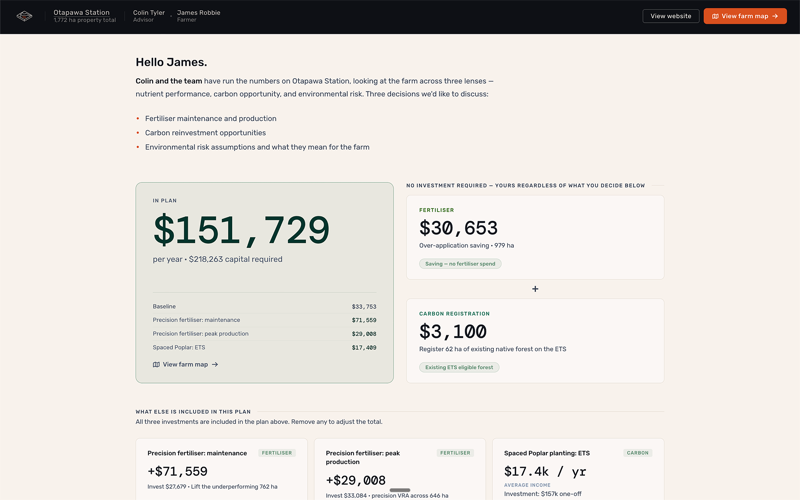
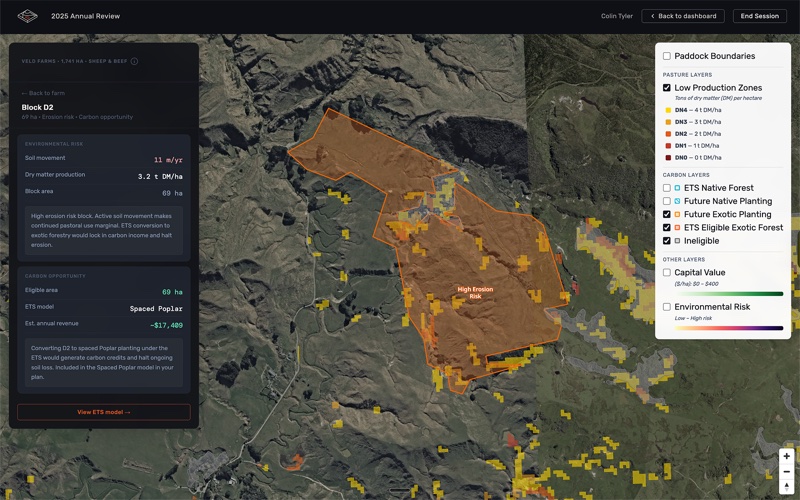
The first move was problem definition. Three directions were on the table: unifying siloed tools, solving the pasture-versus-carbon trade-off that advisors were already resolving manually, or building toward a fuller land-stewardship intelligence layer. The team committed to the trade-off — the most commercially urgent problem, and the one testable against a real farm. The first prototype put the map first. A pilot visit to a North Island sheep and beef farm told us that was wrong. The first question is always about money — how much is this land worth, what does it cost to act, where is the best use of available capital? Once those numbers are clear, the map makes sense. That single conversation restructured the entire information architecture: numbers first, map second, paddock detail third. An AI-augmented workflow made the pace possible — spanning problem framing, product specification, and implementation. When the farmer told us the map was wrong, we pivoted fast.
Role
Design Lead
Outcome
A working prototype, validated against a real North Island farm, selected as a finalist for New Zealand's Field Days Innovation Awards. The farmer independently identified the same paddocks the tool had flagged — not because it told them something new, but because it made visible what they already half-knew.
"Speed without direction is just inertia. The velocity that matters is the kind that gets you in front of a real user fast enough to learn something, and leaves you with enough time to act on it."
A small team, an AI-augmented workflow, and one honest conversation with a farmer: that was enough to define the problem, validate the product, and make the finalist shortlist for New Zealand's largest agricultural innovation event. The constraint was never the team size. It was always clarity about what to build and why.
Client details withheld. Farmer quotes attributed to North Island pastoral stakeholders.
We didn't build VELD to launch it — we built it to find out if the assumption held. If you're trying to answer the same question before you commit to building, let's talk about how fast that can move.
Get in touch →